
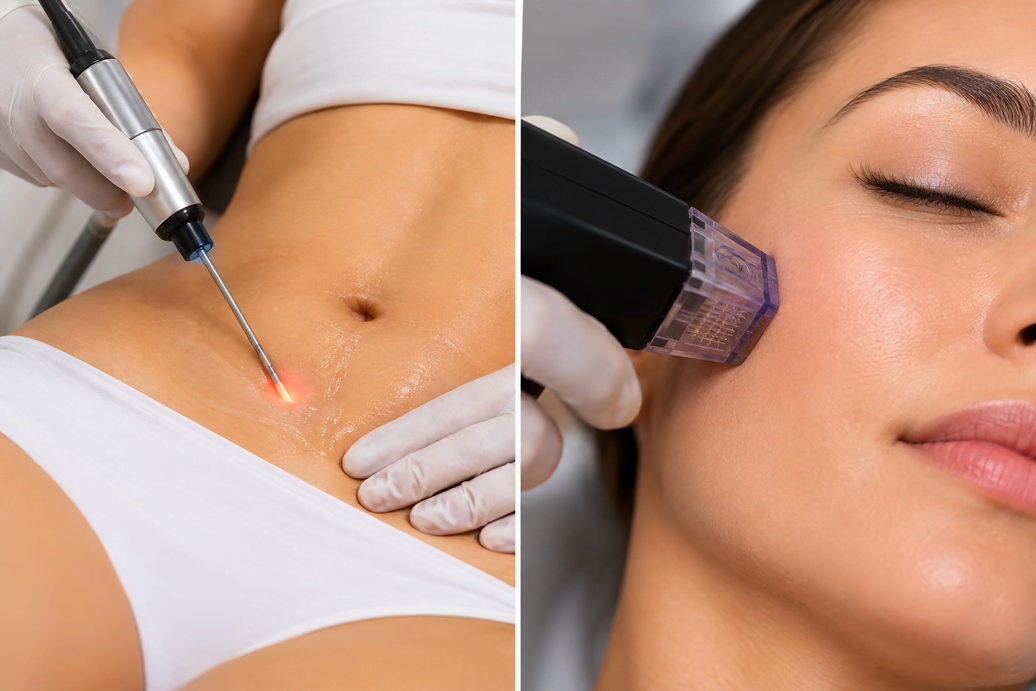
How to Choose Between Quantum RF and Morpheus8: Which One Is Right for You?
- Dr. Mahalia Jackson
- October 25, 2026
- 10 min read
Quantum rf
Table of Contents
- 1. Why Patients Often Compare These Two Treatments
- 2. How Morpheus8 Works
- 3. How Quantum RF Works
- 4. The Core Difference: Surface vs Subdermal Treatment
- 5. Side-by-Side Comparison
- 6. Which Concerns Each Treatment Addresses Best
- 7. Can Quantum RF and Morpheus8 Be Combined?
- 8. Cost Comparison
- 9. Common Misconceptions About Quantum RF vs Morpheus8
- 10. Frequently Asked Questions
- 11. Key Takeaways
Two of the most frequently discussed body contouring and skin rejuvenation technologies from InMode are Morpheus8 and Quantum RF. Patients who encounter both during their research often find themselves asking the same practical question: comparing Quantum RF vs Morpheus8, which one do I actually need?
The answer depends almost entirely on what your primary concern is. These two technologies work at different tissue depths, address different types of problems, and produce different outcomes. Understanding how they compare helps you arrive at your consultation with a much clearer sense of what you are looking for and why.
This content is educational and does not constitute medical advice. Individual results vary. Consult with a qualified provider for a personalized treatment recommendation based on your specific concerns.
1. Why Patients Often Compare These Two Treatments
Morpheus8 and Quantum RF are frequently compared because they share the same manufacturer, both use radiofrequency energy, both can be used on the face and body, and both address concerns related to skin quality and contour. For a patient researching non-surgical improvement of their body or facial appearance, encountering both names without a clear sense of how they differ is entirely understandable.
The confusion typically comes from one key misunderstanding: patients assume that because both use RF energy, they must be doing similar things. The RF energy delivery mechanism, depth, and target tissue are fundamentally different between the two. Learning that difference is the essential first step.
2. How Morpheus8 Works
InMode Morpheus8 skin treatments use a handheld device with an array of microneedles that penetrate the skin from the outside. The needles create controlled micro-injuries in the skin surface while simultaneously delivering RF energy into the dermis at the depth the needles reach, which is typically one to eight millimeters depending on the treatment zone and the provider’s settings.
The primary targets of Morpheus8 are:
- The epidermis and dermis, where skin texture, fine lines, mild laxity, acne scars, and collagen quality changes originate
- The subdermal tissue for deeper skin tightening applications at maximum depth settings
- Surface skin concerns including enlarged pores, crepey texture, uneven tone, and early skin quality decline
Morpheus8 does not remove or dissolve fat. It stimulates the tissue from outside the skin inward, creating a collagen remodeling response that improves the structural quality of the skin and dermis.
3. How Quantum RF Works
Quantum RF body contouring uses a small probe that is inserted directly beneath the skin through a tiny entry point after local anesthesia is applied. The probe delivers focused bipolar radiofrequency energy into the subdermal fat and connective tissue from inside, rather than through the skin surface.
The primary targets of Quantum RF are:
- The subdermal fat layer, where localized fat deposits are permanently dissolved through thermal disruption
- The connective tissue and collagen in the subdermal zone, which contracts immediately and rebuilds over three to six months
- Deeper structural tissue changes that cause contour loss or significant laxity below the level that external devices can reach effectively
Quantum RF does not treat the skin surface directly. Its action begins beneath the skin and works in the tissue layers below the dermis. Surface skin quality changes, fine lines, and superficial texture irregularities are not primary targets of Quantum RF.
4. The Core Difference: Surface vs Subdermal Treatment
The single most important thing to understand in the Quantum RF vs Morpheus8 comparison is the depth of action.
Morpheus8 treats from outside the skin inward, penetrating to a maximum of seven to eight millimeters and primarily affecting the dermis and superficial subdermal tissue. This makes it effective for everything from surface texture to mild structural laxity.
Quantum RF treats from inside the tissue outward, with the probe positioned directly in the subdermal fat and deeper connective tissue. This makes it effective for fat dissolution and deep structural tightening that surface devices cannot produce.
The overlap zone: At Morpheus8’s maximum depth settings and Quantum RF’s most superficial applications, the two treatments can address some overlapping tissue layers. But their primary strengths lie at different depths, and for the majority of clinical presentations, they are complementary rather than interchangeable.
A clinical review on fractional RF microneedling vs subdermal RF treatment confirms that external microneedling RF devices and internally placed RF probes produce different collagen remodeling patterns in the tissue, with the internal probe approach producing more significant effects in the deep subdermal tissue where fat and structural laxity originate.
5. Side-by-Side Comparison
| Factor | Morpheus8 | Quantum RF |
|---|---|---|
| How Delivered | External microneedle handpiece | Internal probe beneath the skin |
| Primary Target | Dermis and superficial subdermal tissue | Subdermal fat and deep connective tissue |
| Fat Reduction | No | Yes, permanent for treated cells |
| Skin Texture and Quality | Yes, primary strength | Limited surface effect |
| Fine Lines | Yes, primary strength | Not a primary target |
| Acne Scars | Yes, primary strength | Not a primary target |
| Skin Tightening | Yes, mild to moderate | Yes, moderate to significant at depth |
| Depth of Action | Up to 7 to 8mm from outside | Deep subdermal, probe-based |
| Anesthesia | Topical numbing cream | Local injected anesthesia |
| Invasiveness | Minimally invasive, no incisions | Minimally invasive, small entry point |
| Downtime | 1 to 3 days | 1 to 3 days |
| Best For | Skin quality, texture, scars, mild laxity | Fat deposits, deep laxity, structural contour |
| Sessions | Typically 2 to 4 | Typically 1 to 3 |
| Cost Per Session | $700 to $1,500 | $2,000 to $3,500 |
6. Which Concerns Each Treatment Addresses Best
Choose Morpheus8 When Your Primary Concern Is:
- Fine lines and wrinkles. Morpheus8’s collagen stimulation in the dermis directly addresses the surface and near-surface collagen deficit that causes lines and wrinkles.
- Acne scarring. Morpheus8’s controlled micro-injury at mid-dermal depth remodels the scar tissue where acne scars originate.
- Skin texture and enlarged pores. The surface action of Morpheus8 refines skin texture and pore appearance effectively.
- Mild to moderate facial laxity. Morpheus8’s collagen-building at dermal depth improves the structural support of mildly loose skin.
- Overall skin quality improvement. For patients whose primary concern is the health and quality of the skin itself rather than fat or structural contour, Morpheus8 is the more appropriate primary tool.
Choose Quantum RF When Your Primary Concern Is:
- Localized fat deposits. Quantum RF is the only one of these two treatments that addresses fat. If fat reduction is part of your goal, Quantum RF is required.
- Deeper structural laxity. Significant subdermal tissue changes that require deep collagen remodeling beyond what external devices can reach are better addressed by Quantum RF’s probe-based approach.
- Post-pregnancy or post-weight-loss body contouring. The combination of localized fat and skin laxity that commonly characterizes these presentations is a direct match for Quantum RF’s dual action.
- Submental and neck contouring. The submental area beneath the chin, where fat and laxity so often coexist, is one of Quantum RF’s most consistent high-impact applications.
For a comprehensive look at all the ways Morpheus8 can be applied across the body and face alongside Quantum RF, the Morpheus8 treatment overview and the Quantum RF overview together provide the full picture of what each platform covers.
7. Can Quantum RF and Morpheus8 Be Combined?
Yes, and for many patients, combining both treatments in a coordinated plan produces the most comprehensive outcome available without surgery.
A practical combination approach: A patient with submental fat, neck laxity, and facial skin quality concerns might use Quantum RF to address the fat beneath the chin and the deep structural laxity in the neck, then use Morpheus8 to improve the surface skin quality of the neck and face simultaneously. Each treatment does what the other cannot, and the combined result addresses the full picture of the patient’s concerns.
Common combination scenarios:
- Quantum RF for the abdomen combined with Morpheus8 for abdominal skin surface texture and stretch marks
- Quantum RF for submental fat combined with Morpheus8 for facial skin quality and early jawline laxity
- Quantum RF for inner thigh fat and deep laxity combined with Morpheus8 for surface skin texture improvement in the same area
Sequencing: Providers typically perform both treatments in the same session or plan them in close temporal proximity, with the specific sequencing determined by the recovery needs of each treatment area and the patient’s schedule.
For a complete look at non-surgical fat reduction and skin tightening options and how the two technologies are combined in practice, that resource covers how providers approach multi-modality planning for patients with both fat and skin quality concerns.
8. Cost Comparison
Morpheus8 typically costs $700 to $1,500 per session depending on the treatment area and the provider, with most patients completing a series of two to four sessions for a total investment of $1,400 to $6,000.
Quantum RF typically costs $2,000 to $3,500 per session depending on the treatment area, with most patients completing one to three sessions for a total investment of $2,000 to $10,500.
For combined treatment plans, the total investment reflects both treatment series. Patients who need both technologies should discuss the full treatment plan and total investment at consultation so they can make an informed decision about sequencing and prioritization.
The cost difference reflects the difference in invasiveness and procedural complexity. Quantum RF requires local anesthesia, probe insertion, and a more involved procedural setup than Morpheus8’s external handpiece treatment. Neither is inherently more cost-effective. Both deliver value when matched to the right clinical indication.
9. Common Misconceptions About Quantum RF vs Morpheus8
“Both are basically the same thing because they both use RF.” Using radiofrequency energy is where the similarity ends. The delivery mechanism, target tissue depth, primary clinical indication, and outcomes profile are all meaningfully different between the two. They are complementary tools from the same manufacturer, not interchangeable versions of the same treatment.
“Quantum RF is better because it is more invasive.” More invasive does not mean better. Quantum RF is more appropriate for its specific indications. Morpheus8 is more appropriate for its specific indications. The right tool for a given concern is better, not the more invasive one.
“I should just get both at the same time to cover everything.” Combining both treatments is clinically appropriate in many cases, but it should be driven by a clinical assessment of your specific concerns, not by a desire to cover all bases regardless of need. A provider-guided plan prevents unnecessary treatment and ensures each modality is being used for the right indication.
“Morpheus8 can replace Quantum RF if I do not want a probe.” For fat reduction, this is not true. Morpheus8 does not reduce fat. If fat deposits are part of your concern, Quantum RF or another fat-targeting treatment is required. Morpheus8 alone will not address subdermal fat regardless of settings.
10. Frequently Asked Questions
The biggest difference is depth of action and primary target tissue. Morpheus8 treats the skin and dermis from the outside in, addressing surface skin quality, texture, fine lines, and mild laxity. Quantum RF treats the subdermal fat and deep connective tissue from the inside through an internally placed probe, addressing fat deposits and deeper structural changes.
For mild to moderate skin laxity, Morpheus8 produces meaningful tightening through collagen stimulation in the dermis. For deeper structural laxity and contour changes in the subdermal tissue, Quantum RF produces more significant results because its probe delivers energy directly into that deeper tissue layer.
Both typically involve one to three days of visible recovery. Morpheus8 involves surface redness and grid marks. Quantum RF involves mild swelling and tenderness at the entry point. For most patients the practical downtime experience is comparable between the two, though the specific nature of the recovery differs.
Your provider will determine the best sequencing based on your specific concerns and which treatment is most urgent. In many cases both can be performed in the same session or in rapid succession. Ask your provider specifically about sequencing at your consultation.
Both are minimally invasive procedures with favorable safety profiles when performed by experienced providers. Quantum RF involves local anesthesia and a probe entry point, which carries a slightly higher procedural complexity than Morpheus8’s external handpiece approach. Neither carries significant risk when performed appropriately by a trained provider. Learn more about your InMode Morpheus8 skin treatment options and Quantum RF options by scheduling a consultation where a qualified provider can assess your specific concerns and recommend the right approach.
Key Takeaways
- Morpheus8 and Quantum RF are both InMode technologies that use radiofrequency energy to improve skin quality and body contour, but they work at different tissue depths and address different primary concerns.
- Morpheus8 works at the skin surface and dermis through an external microneedle handpiece, making it ideal for skin texture, tone, fine lines, acne scars, and mild to moderate skin laxity.
- Quantum RF works beneath the skin surface through an internally placed probe, making it the appropriate tool for fat reduction, deeper tissue tightening, and subdermal structural changes.
- Morpheus8 does not reduce fat. Quantum RF does not address surface skin quality to the same degree as Morpheus8.
- For patients with both surface skin quality concerns and deeper fat or structural laxity, combining both treatments in a coordinated plan addresses the full picture more comprehensively than either treatment alone.
- The treatment areas overlap significantly. Both can be used on the face, neck, and body, but the depth of action and primary target tissue are fundamentally different.
- The right choice depends entirely on your primary concern. Skin quality, texture, and mild laxity point toward Morpheus8. Fat deposits and deeper structural tissue changes point toward Quantum RF.
Which Treatment Is Right for You?
Quantum RF vs Morpheus8 is not a question of which is better in general. It is a question of which is better for your specific concern. If your primary goal is improving skin quality, texture, fine lines, acne scars, or mild laxity, Morpheus8 is the more appropriate primary tool. If your primary goal is reducing localized fat deposits or addressing deep structural laxity, Quantum RF is the right choice. If your goals include both, a combined approach addresses the full picture.
Schedule a consultation with a qualified provider who performs both treatments to receive an honest assessment of your specific concerns and a recommendation grounded in what your skin and body actually need.
References
- Mulholland RS. “Comparative outcomes of subdermal RF probe vs external RF microneedling for tissue remodeling.” PMC. Available at: https://pmc.ncbi.nlm.nih.gov/articles/PMC4631236/
- InMode. “Morpheus8 and Quantum RF Platform Overview and Clinical Indications.” Available at: https://www.inmode.com
- American Board of Cosmetic Surgery. “Choosing between body contouring and skin tightening procedures.” Available at: https://www.americanboardcosmeticsurgery.org/cosmetic-medicine/how-to-choose-between-liposuction-and-noninvasive-fat-reduction-procedures/