
If you have been weighing your body contouring options and want a clear, personalized recommendation based on your specific situation, scheduling a consultation with a qualified provider is the most useful next step. Explore your Quantum RF treatment options and connect with a provider who can evaluate your goals and guide you toward the right approach.
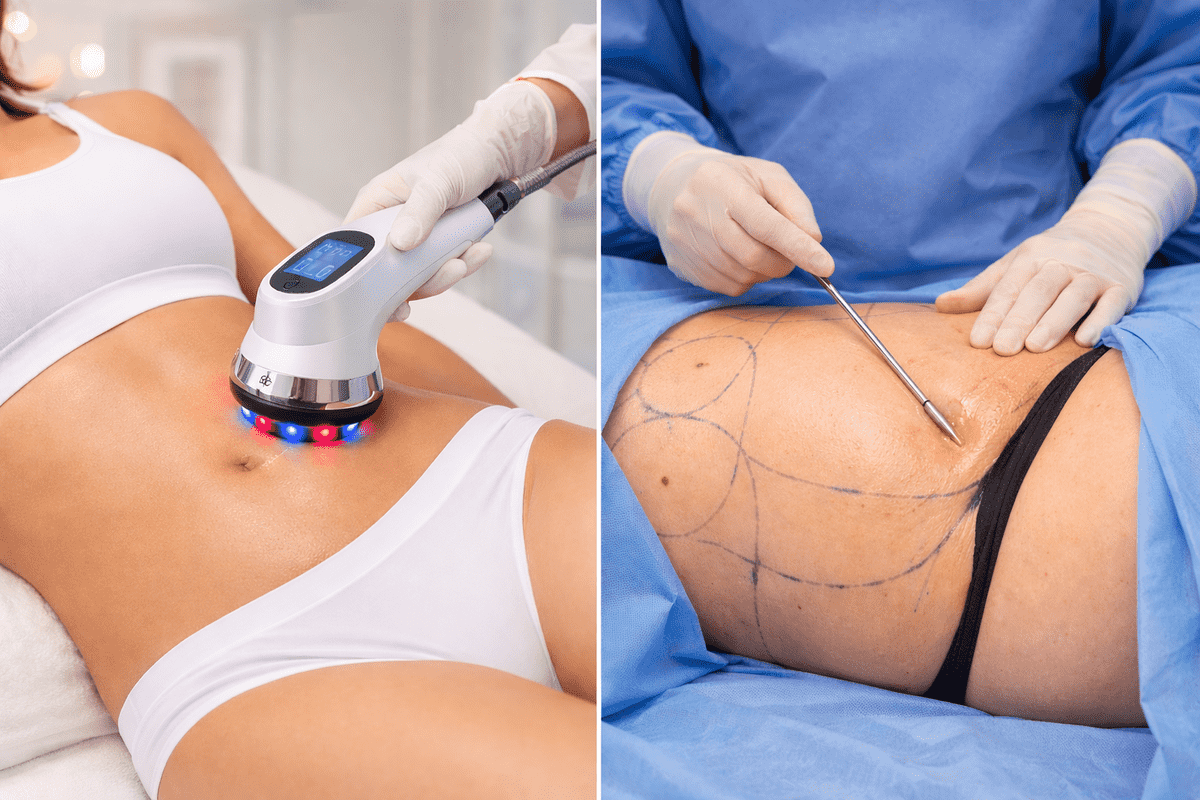
Quantum RF vs. Traditional Liposuction: Which One Is Right for You?
When it comes to reducing stubborn fat that does not respond to diet and exercise, two names tend to come up most often: Quantum RF and traditional liposuction. Comparing Quantum RF vs liposuction is not about deciding which one is better in absolute terms, it is about understanding which one is right for your specific goals, your body, your budget, and your lifestyle.
Both treatments can produce meaningful results. But they work in fundamentally different ways, deliver different outcomes, and come with very different recovery expectations. This guide breaks down exactly how they compare, who is best suited for each, what they realistically cost, and the most common misconceptions patients carry into the decision.
What Is Traditional Liposuction?
Traditional liposuction is a surgical procedure that has been used for body contouring since the early 1980s. A board-certified surgeon makes small incisions in the target area and inserts a thin tube called a cannula to physically suction fat cells out of the body. Depending on the scope of the procedure, it is performed under general anesthesia or local anesthesia with sedation.
Liposuction is effective at removing larger volumes of fat in a single session and can produce dramatic reshaping of the abdomen, thighs, flanks, arms, and other areas.
Traditional liposuction is typically a strong choice when:
- You have significant, well-defined fat deposits you want removed quickly
- You are prepared for a surgical recovery period of one to two weeks or longer
- You want comprehensive reshaping of multiple body areas in a single procedure
- You do not have significant skin laxity concerns that need addressing alongside fat removal
Limitations to be aware of:
- General anesthesia carries its own set of risks that local-only procedures do not
- Liposuction removes fat but does not tighten skin; patients with loose skin may need a separate procedure to address that
- Recovery typically involves swelling, bruising, soreness, and compression garments for several weeks
- Costs generally range from $3,500 to $10,000 or more depending on the areas treated, surgeon fees, and facility costs
According to the American Board of Cosmetic Surgery, liposuction provides more dramatic results than non-surgical alternatives but comes with a longer recovery period and higher procedural risks.
What Is Quantum RF and How Does It Work?
Quantum RF body contouring is a minimally invasive procedure developed by InMode that uses focused radiofrequency energy to address stubborn fat and skin laxity simultaneously. A small probe is inserted beneath the skin through a tiny entry point after local anesthesia is applied. The probe delivers precise RF heat directly into the targeted fat and tissue, dissolving fat cells while simultaneously triggering collagen contraction and stimulating new collagen production.
The result is a dual action that liposuction on its own cannot replicate: fat reduction and skin tightening in a single treatment.
Quantum RF is typically the better fit when:
- You have localized, stubborn fat in specific areas rather than large-volume deposits
- You also have mild to moderate skin laxity in the treatment area
- You cannot or do not want to undergo general anesthesia or surgical procedures
- You need minimal downtime and want to return to normal activities quickly
- You want a more gradual, natural-looking transformation
For a closer look at how this technology works at the tissue level, this overview of non-surgical fat reduction options explains the science behind RF-based body contouring in plain language.
Side-by-Side Comparison
| Factor | Traditional Liposuction | Quantum RF |
|---|---|---|
| How It Works | Surgical suction removes fat cells via cannula | RF probe dissolves fat and tightens tissue simultaneously |
| Invasiveness | Surgical — incisions, cannula, anesthesia | Minimally invasive — tiny entry point, local anesthesia only |
| Anesthesia | General or sedation | Local only |
| Fat Volume | Best for larger fat deposits | Best for localized, stubborn pockets |
| Skin Tightening | Does not tighten skin | Simultaneously tightens skin as fat is reduced |
| Downtime | 1–2 weeks or longer | 1–3 days minimal soreness; most return same day |
| Results Timeline | Visible once swelling resolves (weeks); final at 6 months | Initial results visible immediately; full results at 3–6 months |
| Results Duration | Long-lasting with stable weight | Long-lasting with stable weight and lifestyle |
| Cost Range | $3,500–$10,000+ | $2,500–$5,000 depending on area and sessions |
| Suitable For | Larger fat removal, multiple areas, surgical candidates | Localized fat, skin laxity, non-surgical preference |
| Scarring Risk | Small but visible scars at incision sites | Minimal — tiny entry points that heal discreetly |
The Key Differences in Plain Language
1. How Each Treatment Removes Fat
Traditional liposuction physically suctions fat out of the body during surgery. The results are immediate in terms of volume removed, you leave the procedure with less fat. However, swelling and bruising mean you will not see the final contour for several weeks to months.
Quantum RF uses controlled RF heat to dissolve fat cells, which the body then naturally eliminates through its metabolic and lymphatic systems over the weeks following treatment. This means results develop more gradually, but the approach is far less traumatic to surrounding tissue.
2. Skin Tightening — the Advantage Liposuction Cannot Match
This is one of the most clinically meaningful differences between the two treatments. Traditional liposuction removes fat but does not tighten skin. For patients with good skin elasticity, this may not be an issue. For patients with any degree of skin laxity, liposuction alone can leave the treated area looking loose or uneven after fat is removed.
Quantum RF, by contrast, simultaneously contracts existing collagen fibers and stimulates the production of new collagen as fat is dissolved. The result is both contour refinement and skin firmness in a single treatment. This dual benefit makes Quantum RF particularly well-suited to areas like the abdomen, inner thighs, upper arms, and under the chin, where skin looseness is a common accompanying concern.
3. Recovery and Downtime
Recovery from traditional liposuction typically involves one to two weeks of limited activity, compression garments, and post-surgical discomfort. Returning to strenuous exercise can take four to six weeks, and full resolution of swelling can take several months.
Most Quantum RF patients return to normal daily activities within a day or two of treatment. Mild soreness, temporary swelling, and slight bruising in the treated area are common in the first few days, but these resolve quickly without surgical-level intervention. There are no compression garments required in most cases and no general anesthesia recovery to manage.
4. Cost Comparison
Traditional liposuction typically costs between $3,500 and $10,000 or more depending on the number of areas treated, the surgeon’s fees, and the facility. That figure generally covers a single surgical session that addresses one or more body zones comprehensively.
Quantum RF costs vary by provider and treatment area but typically range from $2,500 to $5,000 for a planned treatment course. Because Quantum RF is minimally invasive and performed in-office, there are no surgical facility or anesthesia administration fees to factor in. For patients treating localized areas rather than large volumes, the cost difference is meaningful — and Quantum RF adds skin tightening that liposuction cannot provide.
5. Who Is Not a Good Candidate for Each
Not every patient is a good fit for every procedure. Understanding the limitations of both helps avoid choosing the wrong tool for the job.
Traditional liposuction may not be appropriate if:
- You have moderate to significant skin laxity in the treatment area
- You are not a candidate for general anesthesia due to health conditions
- You cannot take significant time off for recovery
- You are seeking subtle refinement of localized areas rather than large-volume removal
Quantum RF may not be the right choice if:
- You have large, dense fat deposits that require high-volume removal
- You are looking for immediate, dramatic reshaping in a single session
- Your primary goal is large-scale body transformation rather than targeted contouring
Common Misconceptions About Quantum RF and Liposuction
“Liposuction is always more effective.” For large-volume fat removal, this is often true. For localized pockets of fat combined with skin laxity, Quantum RF frequently produces more comprehensive results because it addresses both concerns at once.
“Quantum RF is just a less effective version of lipo.” Quantum RF and liposuction are different tools for different situations. Quantum RF is not a compromise, it is the appropriate primary treatment for the right candidate.
“Neither treatment is a substitute for weight loss.” This applies equally to both procedures. Both are body contouring treatments, not weight loss solutions. Ideal candidates for either approach are at or near their goal weight but have stubborn localized fat or tissue concerns that diet and exercise alone have not resolved.
“Liposuction results are permanent.” The fat cells removed by liposuction are gone permanently. However, remaining fat cells in the body can expand with weight gain. The same applies to Quantum RF. Long-term results for both depend on maintaining a stable weight.
“Quantum RF requires many more sessions than liposuction.” Liposuction accomplishes its fat removal in one surgical session. Quantum RF typically requires one to three sessions depending on the treatment area and the degree of change desired. For localized contouring, that is a very manageable treatment course.
A Real-World Example
Consider two patients, both in their late 30s, each dealing with stubborn lower abdominal fat that has not shifted despite consistent exercise and a balanced diet.
The first patient has a larger, more diffuse fat deposit covering the full lower abdomen, with firm skin that has retained good elasticity. He wants a dramatic transformation and is willing to take two weeks off work. Traditional liposuction would likely be the more appropriate option for the volume and speed of change he is seeking.
The second patient has a smaller, more localized deposit in the lower abdomen, combined with mild skin looseness from a prior pregnancy. She works full time, cannot take extended time off, and is not interested in general anesthesia. Quantum RF would almost certainly be the better recommendation for her, it addresses both the fat and the skin laxity, fits her lifestyle, and does not require surgical recovery.
The right answer is never the same for everyone. A thorough consultation with a qualified provider is the only way to determine which approach actually fits your individual situation.
Frequently Asked Questions
For large-volume fat removal, traditional liposuction generally produces more dramatic single-session results. For localized fat deposits combined with skin laxity, Quantum RF can deliver comparable or more comprehensive outcomes because it addresses both fat and skin in one treatment.
A Quantum RF session typically takes one to two hours depending on the treatment area. Traditional liposuction can vary widely but generally takes two to four hours, plus anesthesia administration and surgical facility time. Recovery time is significantly shorter with Quantum RF.
Yes. Some patients choose liposuction for high-volume fat removal and follow with Quantum RF to address skin tightening and refine remaining contours. Your provider can assess whether a combined approach makes sense for your goals.
Both treatments permanently remove the treated fat cells. Long-term results for both depend on maintaining a stable weight and healthy lifestyle. Neither treatment prevents new fat accumulation in other areas if weight is gained after the procedure.
A personalized consultation with a qualified provider is the only reliable way to answer that question. Factors including the volume of fat, degree of skin laxity, health history, downtime tolerance, and aesthetic goals all influence which approach is genuinely appropriate for each individual.
Ready to Find Out Which Approach Fits Your Goals?
Disclaimer
This content is for informational purposes only and does not constitute medical advice. Individual results vary. Consult with a qualified healthcare provider before undergoing any aesthetic treatment.